

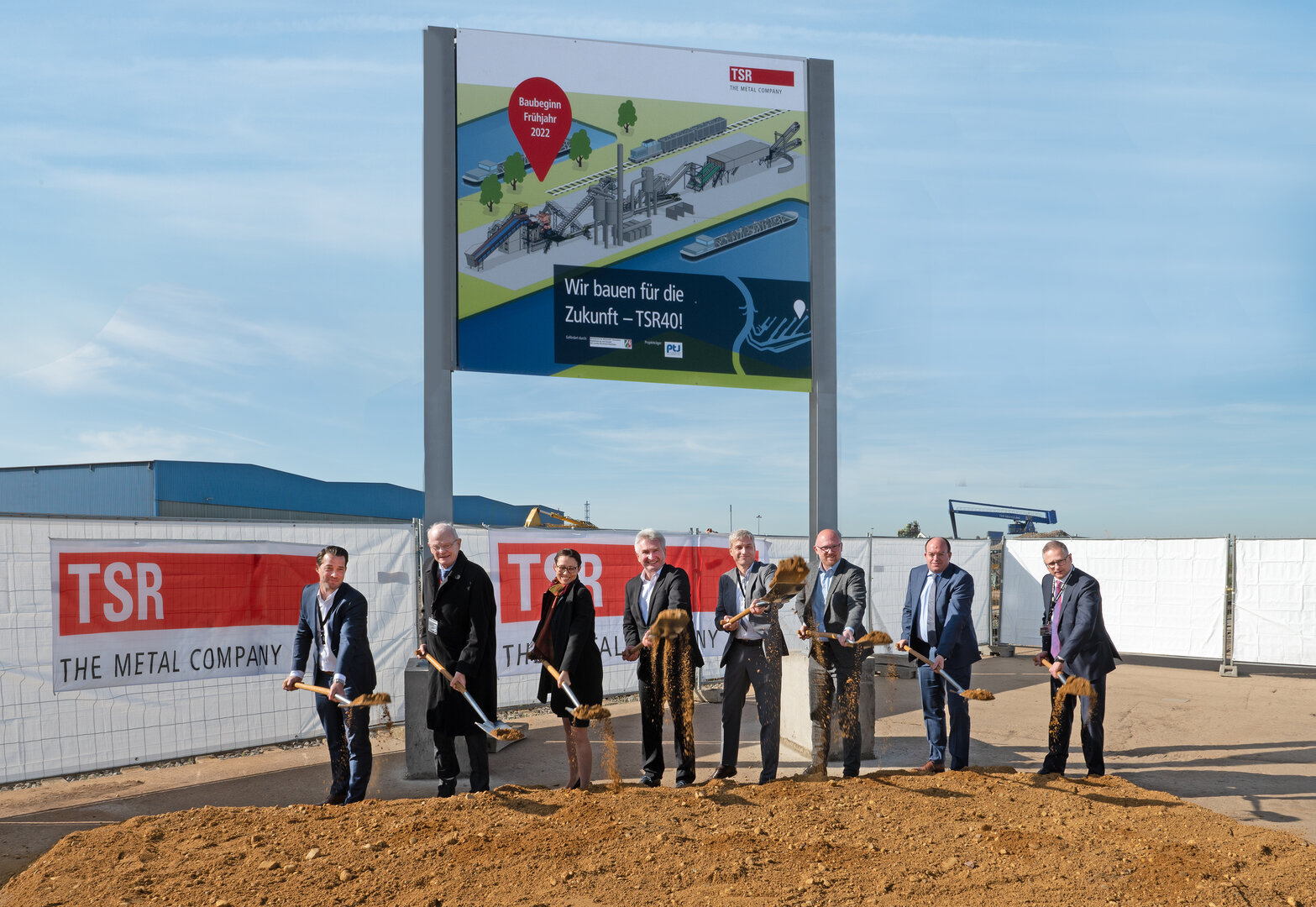
Lünen. Bernd Fleschenberg (COO TSR Recycling GmbH & Co. KG) and Christian Blackert (Regional Manager TSR Recycling GmbH & Co. KG) were joined by NRW Minister for Economic Affairs Prof. Andreas Pinkwart, Sören Link (Mayor of Duisburg), Markus Bangen (Board Chair of Duisburger Hafen AG), Norbert Rethmann (Honorary Chair of the Supervisory Board of RETHMANN SE & Co. KG), Dr Rosa Peter (Hüttenwerke Mannesmann GmbH) and Dr Arnd Köfler (CTO thyssenkrupp Steel Europe AG) at TSR’s plant in Duisburg to symbolically cut the first sod – officially signalling the start of the construction of a new recycling facility at the site.
The innovative technology that will be used at this new facility was developed as part of the REDERS research project, which aims to both intensify iron and steel recycling as well as to reduce CO2 emissions caused by steel production (REDERS is a German acronym for ‘reducing CO2 emissions by increasing the rate of recycled materials in steel production’). This new recycling system will play an important role as the steel industry transitions towards more climate-neutral production processes.
Plans are for the new facility, which is being built on a section of the 130,000m² site operated by TSR’s Duisburg branch, to be commissioned by the end of 2022. It will then begin producing TSR40 on an industrial scale, a recycled product developed in collaboration with the project partners thyssenkrupp Steel and Hüttenwerke Krupp Mannesmann. By using state-of-the-art shredding, dust extraction and separation technologies, standard input materials – such as end-of-life vehicles – can be used to produce TSR40, a novel product that will enable the share of recycled material used in the converter process to be increased and and can thereby reduce CO₂ emissions in steel production.
NRW Minister for Economic Affairs Prof. Andreas Pinkwart commented: “Transforming today’s industry into the future-proof, climate-friendly industry of tomorrow is a task that requires effort from everyone. As we head towards this goal, we must unite the strengths of the different industries and make the most of the potential of such collaborations. The way the North Rhine-Westphalian steel and recycling industries have worked so closely together on the REDERS project has shown how this can be done here at this long-established site in Duisburg. I am convinced that this project will be a game changer for the whole of the sector.” Back in August 2021, he had handed over notification of a grant award to the project consortium confirming that their project would be receiving a grant amounting to 6.4 million euros as part of the ‘Programme for the efficient use of energy, renewable energies and the saving of energy', known simply as ‘progres.nrw’.
“This project presents us with the opportunity to make rapid progress when it comes to cutting CO2 emissions. Besides our long-term goal of transforming our plant to hydrogen-based direct reduction, we are also making the very most of every opportunity to reduce CO₂ emissions in the existing blast furnace process as well. Using high quality, scrap-based recycled material in our blast furnaces is an important step in this direction,” explained Dr Arnd Köfler, who is in charge of the project at thyssenkrupp Steel.
“The construction of the new plant and the new TSR40 product will help to provide recycled raw materials for industrial use and shift the raw materials supply in Germany and Europe more towards recycled materials”, TSR Managing Director, Bernd Fleschenberg, added. “With TSR40, we can help meet the industry’s future demand for raw materials using recycled materials. Our plant in Duisburg is, therefore, acting as a lighthouse project that can serve as a model for other material streams – especially in these times of disrupted supply chains.”